


Key Takeaways:
- Open-to-buy (OTB) is a purchasing budget that tells you exactly how much you can afford to spend on new inventory during a specific period, based on your planned sales, what you already have on hand, and what you already have on order.
- Calculating OTB by category rather than for your whole store is what makes it actually useful: a $20,000 total OTB budget split across four categories tells you something. A single $20,000 number tells you almost nothing.
- OTB is a living number. Retailers who update it weekly or bi-weekly as sales come in use it to make faster, more confident buying decisions throughout the period.
Most independent retailers overbuy when things are going well and underbuy when they are not. Both are expensive mistakes: overbuying ties up cash in slow-moving inventory or deadstock; underbuying means empty shelves and missed sales during your best weeks. Open-to-buy is the inventory planning strategy that addresses both problems before they arise.
This guide explains what OTB is, how to calculate it, how to build a plan around it, and where retailers tend to go wrong. There is also a worked example with real numbers so you can see exactly how it plays out in practice.
What Is Open-to-Buy?
Open-to-buy is a purchasing budget. It tells you the maximum amount you can spend on new inventory during a specific time period without overstocking or running short on cash. It is not a target; rather, it is a ceiling calculated from your planned sales, your existing inventory, and anything you have already ordered.
The term comes from the idea that your buying budget is either “open” (available to spend) or “closed” (already committed). OTB makes that boundary explicit before you walk into a vendor meeting or place a reorder.
PRO TIP!
OTB is most commonly used in apparel and specialty retail but applies to any business where buying decisions significantly affect cash flow.
What Does Open-to-Buy Mean in Practice?
Think about a boutique owner heading into the holiday season. She knows from last year that November and December are her biggest months, and she is tempted to stock up heavily. But without an OTB calculation, she has no concrete basis for how much is too much. She might spend $40,000 on inventory when her sales history only justifies $25,000, then spend January and February trying to clear dead stock at markdown prices.
OTB gives her a specific, defensible number before she orders. It also tells her how to split that budget across categories so she is not overspending on outerwear while running short on accessories.
The Open-to-Buy Formula
The full OTB formula is:
OTB = Planned Sales + Planned Markdowns + Planned Ending Inventory – Beginning Inventory – On-Order Inventory
Each variable does specific work:
- Planned Sales is your revenue forecast for the period.
- Planned Markdowns accounts for the portion of inventory you expect to sell at a discount rather than full price.
- Planned Ending Inventory is how much stock you want to have left at the end of the period.
- Beginning Inventory is what you actually have on hand right now.
- On-Order is anything already committed to a supplier but not yet received.
If you do not yet have on-order inventory, a simplified version works fine: OTB = Planned Sales + Planned Markdowns + Planned Ending Inventory – Beginning Inventory. The on-order adjustment matters most when you have already placed orders for the period and need to know how much budget remains.
How to Calculate Each Input
Getting accurate inputs is what separates a useful OTB plan from a guess. Here is where each number comes from:
- Planned Sales: Use last year’s sales for the same period as your baseline, then adjust for growth, new products, or market changes. A 10% year-over-year increase is a reasonable starting assumption for a healthy store.
- Planned Markdowns: Industry standard runs 10% to 20% of planned retail sales value. Higher for fashion and seasonal categories, lower for staples.
- Planned Ending Inventory: How much stock do you want going into the next period? For most categories, a four to six week supply is a reasonable target.
- Beginning Inventory: Your actual on-hand stock at cost value, pulled from your inventory system.
- On-Order Inventory: The total cost value of any purchase orders already placed but not yet received.
Discover Advanced Analytics and Custom Reports
Speak with a product specialist and learn how KORONA POS can work for your business.
A Real-World OTB Example
Sophie runs a women’s boutique in Oregon. She is planning her holiday buy covering November and December. Here are her inputs from her KORONA Studio reports:
- Planned Sales: $85,000 (based on $77,000 last year, adjusted up 10%)
- Planned Markdowns: $8,500 (10% of planned sales)
- Planned Ending Inventory: $18,000 (she wants healthy stock going into January clearance)
- Beginning Inventory: $42,000 (current on-hand at cost)
- On-Order: $9,000 (a sweater order she already placed in September)
Plugging those in: $85,000 + $8,500 + $18,000 – $42,000 – $9,000 = $60,500
Sophie has $60,500 open to buy for the holiday season. That is her ceiling before she places another order. She then breaks it down by category using her historical sell-through rates pulled from her POS system:
| Category | % of Sales | OTB Allocation |
|---|---|---|
| Dresses and tops | 38% | $22,990 |
| Outerwear | 25% | $15,125 |
| Accessories | 22% | $13,310 |
| Basics and loungewear | 15% | $9,075 |
| Total | 100% | $60,500 |
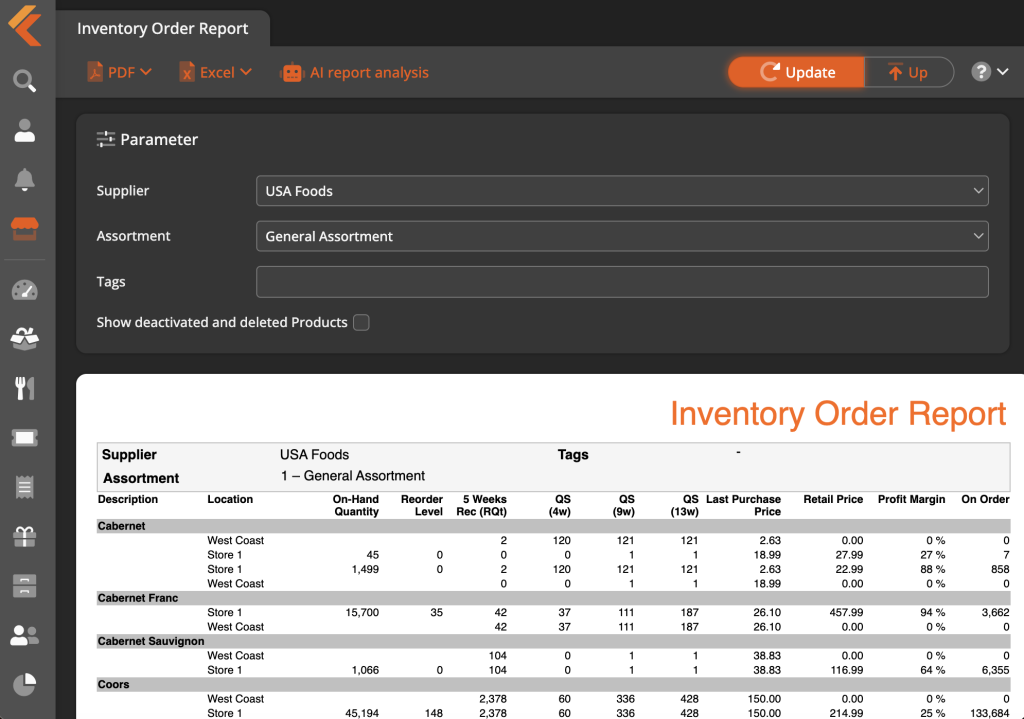
In KORONA Studio, Sophie pulls the Inventory Order Report (Evaluations tab), filtered by category, which shows her QS columns for the past 4, 9, and 13 weeks of sales, along with the 5-week recommended order quantity for each product. That 13-week column covering August through October tells her exactly which SKUs in each category were moving and at what velocity, which is what she uses to allocate her OTB dollars within each category rather than guessing.
How to Build an Open-to-Buy Plan
Step 1: Set Your Planning Period
Monthly works for most retailers and aligns naturally with supplier billing cycles and financial reporting. Fast-moving categories like beverages, consumables, or trend-driven accessories may warrant a two-week cadence. Seasonal businesses doing a single large buy for a quarter can plan at the quarterly level, though monthly reviews are still worth building in to catch deviations early.
Step 2: Pull Your Historical Sales Data by Category
This is where your POS system does the heavy lifting. You need category-level sales history, not just total store revenue. Total revenue tells you how the business performed; category-level data tells you where to put your OTB dollars. In KORONA Studio, the Inventory Order Report gives you 4-week, 9-week, and 13-week sales quantities by product and supplier, which is the most useful baseline for building your planned sales forecast at the category level.
Step 3: Run the Formula by Category
Do not run OTB once for the whole store and call it done. Run it separately for each major product category. A blended store-level OTB number obscures the fact that you might be dramatically over-inventoried in one category and severely underbought in another. Category-level OTB is what actually guides buying decisions.
Step 4: Allocate Within Each Category by SKU Performance
Once you have your OTB budget by category, use your sell-through data to decide which specific products get reordered and in what quantities. SKUs with strong 13-week sell-through rates get priority. Slow movers get reduced allocations or none at all. This is the step where OTB planning also starts to function as an SKU rationalization tool.
Step 5: Update It as the Period Progresses
OTB is a living number, not a one-time calculation. If your sales in the first two weeks of November run 15% ahead of plan, your OTB opens up: you have more budget available than you thought. If they run behind, you hold back. Retailers who treat OTB as a monthly snapshot and never revisit it are missing most of its value.
PRO TIP!
Set a recurring 30-minute calendar block every two weeks to update your OTB figures. It takes less time than you think and it keeps you from making reactive buying decisions when a vendor calls with a “limited time offer.”
Common Open-to-Buy Mistakes to Avoid
Even retailers who understand OTB in principle tend to make the same errors when they apply it. Here are the ones that matter most:
- Calculating OTB for the whole store instead of by category. A blended number gives you false confidence. A store-level OTB of $30,000 tells you nothing about whether you are over-inventoried in workwear and underbought in accessories.
- Using retail value instead of cost. OTB is a purchasing budget. Run it at cost throughout.
- Ignoring on-order inventory. If you have already placed orders for the period and exclude them from the formula, your OTB will be overstated and you will overbuy.
- Treating it as a one-time calculation. Sales deviate from plan every period. An OTB that is not updated mid-period is just a stale number.
- Letting vendors override it. A supplier offering you a deal that blows past your OTB ceiling is not a deal. It is a cash flow problem dressed up as an opportunity.
PRO TIP!
If a vendor is pressuring you to buy more than your OTB allows, tell them you are at budget for the period and ask whether the terms can be applied to your next order cycle instead. A good vendor relationship accommodates that conversation. A transactional one does not, which is also useful information.
Open-to-Buy vs. Just-in-Time Inventory
OTB and just-in-time (JIT) inventory are sometimes confused because both aim to avoid overbuying. They work at different levels of your operation. OTB is a financial planning tool: it sets the budget ceiling for a buying period before you order. JIT is a replenishment philosophy: it minimizes the stock you hold at any given moment by ordering frequently and in smaller quantities.
They work well together. An OTB plan gives you the total budget for the period; a JIT approach tells you to use that budget in multiple smaller orders rather than one large upfront buy. For retailers with reliable suppliers and fast-moving SKUs, combining both methods keeps cash flow healthy and shelves stocked without the carrying costs of large inventory positions.
Open-to-Buy Turns Inventory Buying From a Gut Call Into a System
Buying inventory without an OTB plan is like setting a personal budget by feel rather than by looking at your bank account. You might be fine, or you might wake up in February wondering where your working capital went. The retailers who manage cash flow most effectively are not the ones who guess best; they are the ones who build a simple, repeatable planning process and stick to it.
OTB is that process. Once it is in place, every buying decision gets easier, every vendor conversation gets more focused, and the beginning of every season starts from a position of clarity rather than optimism.
Open-to-Buy (OTB): FAQs
Does open-to-buy work for stores with very unpredictable sales?
- Yes, though the planning period should be shorter. Instead of monthly OTB, retailers with volatile demand do better with two-week cycles and conservative planned sales estimates. The goal is having a structured ceiling that prevents you from overcommitting capital when demand is uncertain.
Should open-to-buy be calculated in units or dollars?
Either works, and some retailers use both. Dollar-based OTB is more common because it directly ties to your cash flow and budget. Unit-based OTB is useful when you need to plan at the SKU level, particularly for categories with a wide range of price points where dollar averages can be misleading.
Can open-to-buy help with markdown planning?
- Directly, yes. Planned markdowns are a built-in variable in the OTB formula, which means every time you calculate OTB you are explicitly accounting for the inventory you expect to sell below full price. Retailers who track their actual markdown rate against their planned rate over time get progressively better at forecasting and end up with less residual clearance inventory each season.